

About 5 minutes · 4 short sections
Safety foundations
Understand the principles. Know what to ask next.
Leave with a shared vocabulary and one useful safety conversation to have before a class or household decision.
For: New learners, household members and anyone refreshing the basics. No ownership is required.
Understand what the principles protect
Firearm safety begins with where the muzzle points, keeping fingers away from the trigger until the appropriate moment, and knowing what is in and beyond the intended target area. A mechanical safety does not replace those responsibilities. Treat an assurance that something is unloaded as information to verify through the right instruction, not permission for careless handling.
This guide introduces the ideas. Learning how to check or operate a particular firearm belongs with its exact manual and qualified, supervised instruction. If you are unfamiliar with it, leave it alone and ask the responsible person for help.
Give unfamiliar words a plain meaning
The muzzle is the opening at the end of the barrel. The action is the mechanism involved in loading, firing and unloading; its design varies. A cartridge is a complete round of ammunition, while a projectile is the part that leaves the barrel. These words help you ask a precise question; recognizing them does not establish that you can operate a particular model.
- Ask for the exact manufacturer and model rather than guessing from appearance.
- Ask who will explain the safety briefing and demonstrate the equipment.
- Ask for clarification before the activity proceeds if a word or instruction is unclear.
From SAAMI · Glossary
Make access a household responsibility
Storage planning is about preventing unauthorized access, including by children and visitors. A hiding place is not a secure-storage plan. Discuss the storage method, who controls access and how arrangements change when guests arrive or circumstances change.
For a household conversation, start with roles rather than equipment: “Who is responsible for checking the arrangements before visitors arrive?” Someone who does not own a firearm can still raise that question. Keep access details and private routines out of public profiles or group conversations.
Try a practical planning question
Fictional example: Jo is visiting a relative with children this weekend. Jo does not own a firearm and is unsure whether any are present. A useful question is, “Are there firearms in the home, and how will children and guests be kept from accessing them?” The goal is a clear answer about arrangements, not an argument about someone’s experience.
Choose one question that matters in your own context. It might concern household access, the right manual, or who will supervise a first class. Write that question in your own notebook; this page does not collect it.
Four parts of a safety conversation
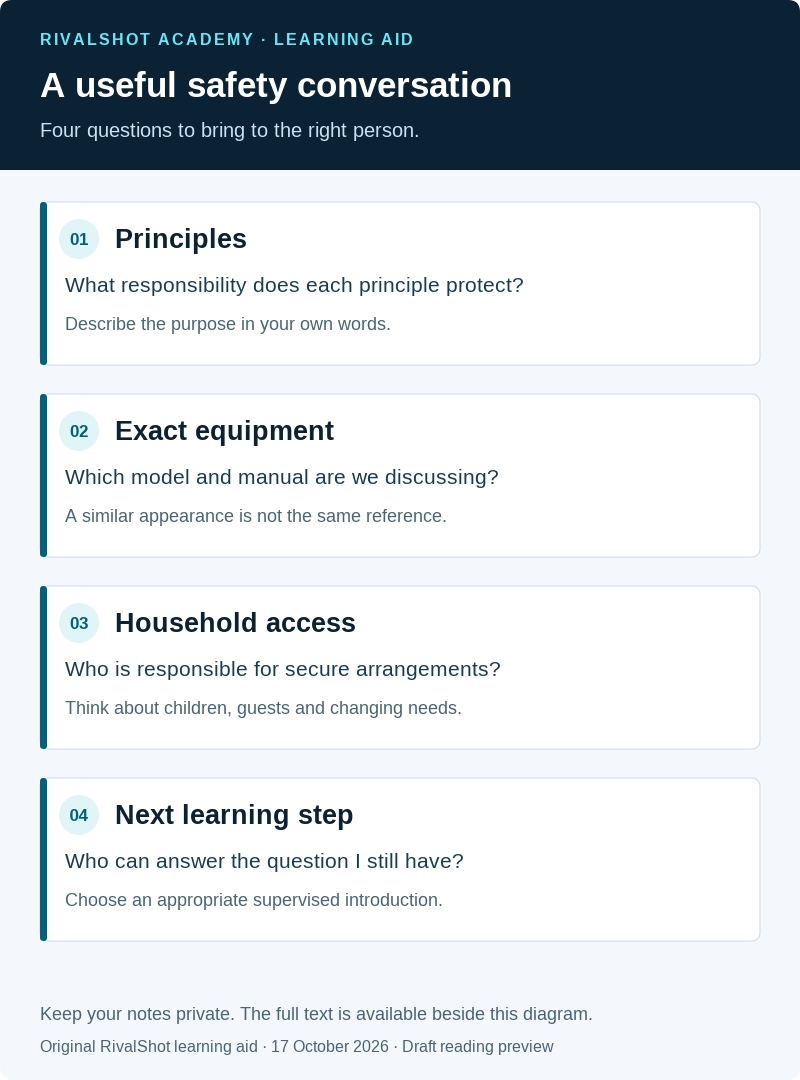
Use the map to organize questions. It is a learning aid, not an operating procedure.
Download the figureDownload as text
Read the figure as text
A USEFUL SAFETY CONVERSATION Four questions to bring to the right person. 01. Principles What responsibility does each principle protect? Describe the purpose in your own words. 02. Exact equipment Which model and manual are we discussing? A similar appearance is not the same reference. 03. Household access Who is responsible for secure arrangements? Think about children, guests and changing needs. 04. Next learning step Who can answer the question I still have? Choose an appropriate supervised introduction. Keep your notes private. This aid does not record completion.
Think it through
- Which responsibility can you explain clearly already?
- Which question needs an answer from a household member, instructor or manufacturer?
Keep your answers in your own notes. Nothing is submitted or scored on this page.
A question from “Every firearm has its own manual and needs its own teacher”
A returning owner plans to borrow a friend’s firearm for a range session next week. The friend says, “It works just like the one you had in the nineties.” The returning owner has never seen this model’s manual and has not used one since. What is the best plan?
- Watch an online video about a similar-looking model the night before, then follow along with it at home.
- Plan to ask range staff for a quick rundown of the controls once they are set up on the firing line.
- Get this exact model’s manual, read it, and have a qualified person walk them through it before handling.
- Rely on the friend’s comparison, since the friend knows both models and the safety principles are the same.
A question from “Children and visitors”
Your nine-year-old is invited to a sleepover at a classmate’s home you have never visited. You already plan to ask about allergies, pets and who will be supervising. What is the best approach to firearms?
- Ask about firearms only if something about the family, such as their hobbies, makes you guess that they own one.
- Skip the question and remind your child that if they see a firearm, they should not touch it and should tell an adult.
- Ask, in the same tone as the allergy question, whether there are firearms and if they are locked; adjust plans if unclear.
- Leave firearms off the list for now to avoid offending a new family, and bring it up once you know them better.
Choose your next step
Sources
- NSSF · Firearm safety rulesFoundational safety principles, exact-model learning and protective equipment. Checked 2026-10-17.
- Project ChildSafe · Securing your firearmPreventing unauthorized access and choosing an appropriate storage approach. Checked 2026-10-17.
- SAAMI · GlossaryTerminology for firearm systems, cartridges and projectiles; a reference glossary, not operating instruction. Checked 2026-10-17.
Original RivalShot explanatory prose and examples. Existing course manuscripts and first-visit planning aid retain their source identities.