

About 5 minutes · 4 short sections
Notice, Check, Choose
A practical start to everyday awareness.
Separate what you observed from what you assumed, then choose a proportionate next step.
For: Everyday learners, travelers, students and staff. This path does not require firearm ownership.
Notice the situation you are actually in
Look for ordinary context: where people are waiting, what staff are doing, and whether there is an obvious explanation for a change. A quiet library becomes noisier when school ends. An unfamiliar queue may simply have a different check-in process. A change deserves context, not an automatic threat label.
Describe behavior and circumstances rather than treating appearance or identity as evidence of danger. DHS makes that distinction explicit in its public reporting guidance.
From DHS · Recognize suspicious activity; University of Michigan DPSS · Training and presentations
Separate observation from the story
An observation is something you saw or heard: “The entrance is crowded and a staff member is redirecting people.” An interpretation adds an explanation: “Something dangerous must have happened.” The interpretation may be wrong.
Ask what information is missing and whether you can obtain it without taking on a role that is not yours. A sign, an announcement or a question to staff may answer it. You can also choose more space or leave an uncomfortable situation without deciding that another person has bad intentions.
Choose a next step that fits the information
The useful choice may be to continue, adjust your plans, ask staff, or leave. If there is an immediate emergency, use the appropriate emergency service for your location. Ordinary awareness is not a promise to predict events, investigate people or handle a problem alone.
Fictional example: a café pickup area is crowded, and someone raises their voice about an order. You know the words are about a missing drink; you do not know the person’s intentions. You could wait away from the counter and ask a staff member where completed orders are being placed. That addresses your immediate need without adding a confrontation.
From University of Michigan DPSS · Training and presentations
Practice the reasoning in another setting
Try the same three questions at a fictional bus station, event entrance or reception desk: What did I notice? What am I assuming? What useful choice is available? The point is to explain your reasoning, not to label the busiest place or the most unfamiliar person as the problem.
The full course gives you more examples and reflection. Its knowledge checks use a different situation so you can see whether the distinction transfers. A browser or VR scenario can later exercise the same objective; reading this page does not record a scenario session.
From observation to a useful choice
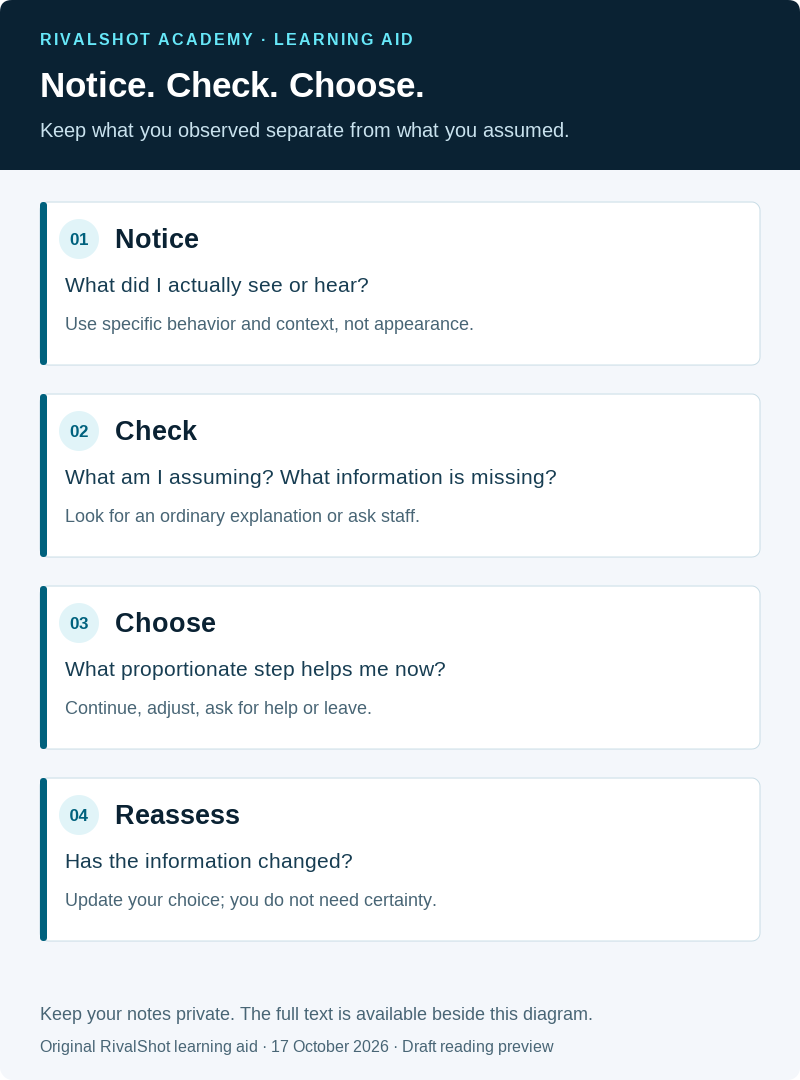
An original reasoning aid. No appearance-based risk score or prediction is implied.
Download the figureDownload as text
Read the figure as text
NOTICE. CHECK. CHOOSE. Keep what you observed separate from what you assumed. 01. Notice What did I actually see or hear? Use specific behavior and context, not appearance. 02. Check What am I assuming? What information is missing? Look for an ordinary explanation or ask staff. 03. Choose What proportionate step helps me now? Continue, adjust, ask for help or leave. 04. Reassess Has the information changed? Update your choice; you do not need certainty. Keep your notes private. This aid does not record completion.
Think it through
- Describe a recent ordinary change without adding a motive.
- What missing information would alter your next step?
Keep your answers in your own notes. Nothing is submitted or scored on this page.
A question from “Learn the baseline: what normal looks like here”
You stop at a branch library on a weekday afternoon. It is quiet: a few people reading, a staff member reshelving books, the soft beep of the self-checkout. At 3:30 a group of teenagers arrives from the school next door, laughing, and the noise level rises. Which response best uses the idea of a baseline?
- Keep a close eye on the teenagers for the rest of your visit, since they are what changed the room's baseline.
- Notice the shift, link it to school letting out next door, update your sense of normal for 3:30 and carry on.
- Save the baseline habit for busier places, since a quiet library like this one rarely needs your attention.
- Pack up and head to a quieter branch, since a sudden change from the baseline is itself a sign of trouble.
A question from “Observation or assumption: what you saw versus the story”
At a bus shelter, a person standing near you talks loudly into their phone, hangs up, mutters to themselves and starts to pace. You notice you feel uneasy. Which response makes the best use of what you saw and what you feel?
- Tell yourself the unease is just bias, and stay in your spot right beside them until the bus finally pulls in.
- Ask them directly what is wrong, so you can find out for certain whether there is anything to worry about.
- Conclude from the muttering that they are unstable, and quietly warn the others waiting to keep their distance.
- Note what you actually saw and heard, then move a few steps along the shelter where you can still see the bus.
Choose your next step
Sources
- DHS · Recognize suspicious activityObservation should concern behavior and situations, not appearance or identity. Checked 2026-10-17.
- University of Michigan DPSS · Training and presentationsEveryday awareness and personal safety as education available to a broad campus community. Checked 2026-10-17.
Original RivalShot explanatory prose and examples. Existing course manuscripts and first-visit planning aid retain their source identities.