

About 6 minutes · 4 short sections
Read the Numbers Before the Headline
Interpret a quantity, a chart and its limitations without turning a small result into a universal claim.
Practice with clearly fictional classroom data, then carry the same questions into a published reference. No physical experiment is part of the exercise.
For: Readers interested in ammunition terminology, measurement and scientific evidence.
Name the quantity and its unit
A cartridge is a complete round; a projectile is a component; caliber can be part of a naming or approximate-diameter description. Keep product identity separate from a measured quantity. A caliber number alone is not a complete specification or compatibility determination.
Mass, speed, energy and distance are different quantities. A numerical comparison needs the quantity, unit and conditions. Two meters and 200 centimeters can describe the same length; two meters and two seconds cannot. Extra decimal places do not create additional knowledge.
From SAAMI — Cartridge; SAAMI — Caliber; NIST — Guide to SI, Chapter 4
Show the observations, not just the average
In our fictional mass example, the assigned reference is 100.0 g. Instrument A reports 102.0, 102.1 and 101.9 g; B reports 99.5, 100.0 and 100.5 g. A has a smaller displayed range but is offset from the reference. B’s average equals the reference, while its readings spread more widely.
The dot plot shows all six readings. Its vertical jitter only separates marks. The three observations per instrument are invented and cannot qualify either instrument. A sample range is not automatically a measurement-uncertainty interval or a guarantee about future results.
From NIST — TN 1297, Appendix D1: Terminology; NIST — Basic definitions of uncertainty
Compare the method before the conclusion
Read the axes, units, sample size, conditions and legend. Is a mark an observation, an average or a model output? What does an interval mean? If its definition is missing, keep that question open. A smooth curve is not proof that every point was measured.
Our second fictional example compares classroom-cart reports: North has five trials and a mean of 10 s under setup N; South has three trials and a mean of 9 s under setup S. The means differ, but the setups differ too. The table alone cannot show a cause or a universal improvement.
Keep the claim within its evidence
Interior, exterior and terminal ballistics organize different physical questions. A flight observation alone does not prove every impact outcome. Ask what evidence connects the reported measurement to the proposed conclusion, and distinguish a publisher’s product statement from an independent study.
End with a claim card: exact claim, original source, supplied evidence, missing assumptions and narrower conclusion. Choose the next study topic that resolves your actual gap—terminology, units, general mechanics or measurement statistics. Any practical laboratory activity belongs with its qualified institution and supervision.
Tight grouping can still be offset
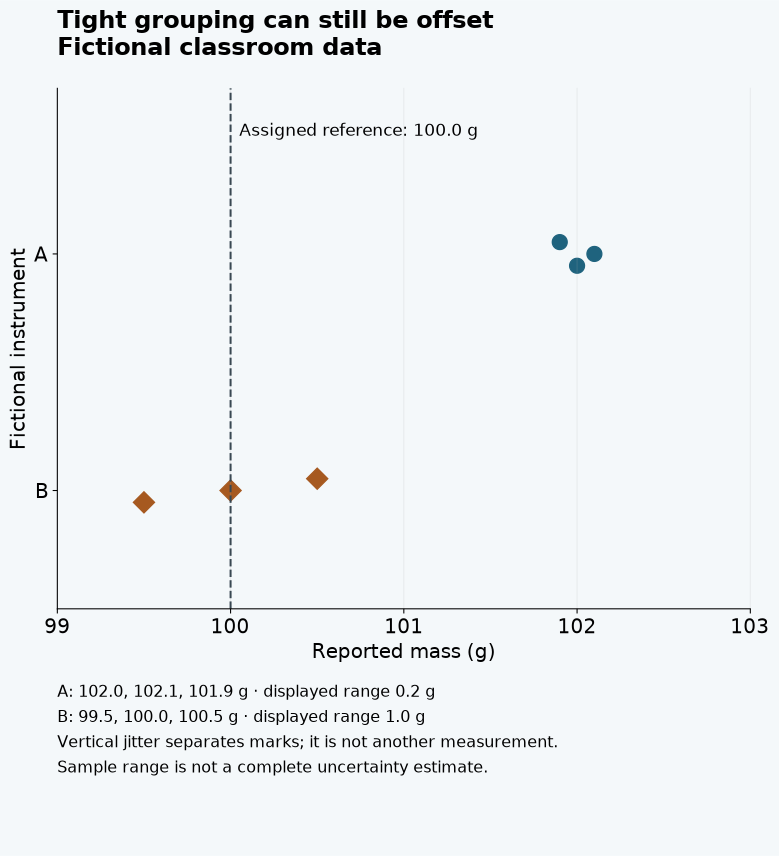
Original classroom data, unrelated to firearm or ammunition testing. Vertical jitter separates marks. Three observations do not qualify an instrument.
Download the figureDownload as text
Read the figure as text
Fictional classroom mass readings; not firearm or ammunition data. Assigned reference for the exercise: 100.0 g. Instrument A: 102.0, 102.1, 101.9 g. Mean: 102.0 g. Displayed range: 0.2 g. Instrument B: 99.5, 100.0, 100.5 g. Mean: 100.0 g. Displayed range: 1.0 g. A agrees more closely with itself in this sample but is offset from the reference. B has a larger displayed spread. Three invented readings cannot qualify either instrument. Vertical jitter only separates the marks. Range is not automatically a measurement-uncertainty interval. Report-card exercise (also fictional): North: 5 classroom-cart travel-time trials, mean 10 s, setup N. South: 3 trials, mean 9 s, setup S. The differing setups and sample sizes prevent a universal or causal conclusion from the means alone. Reading worksheet: quantity / value and unit / sample / method / conditions / variation or uncertainty definition / supported conclusion / unanswered question / original source and edition.
Think it through
- What quantity is reported, and in which unit?
- What does the sample show, and what remains unknown?
- Which detail would you ask the publisher to clarify?
Keep your answers in your own notes. Nothing is submitted or scored on this page.
A question from “Read the quantity before the number”
A summary compares a value in joules with one in meters per second and calls the larger numeral better. What is the main problem?
- The figures describe different quantities, and the comparison has no defined outcome.
- The comparison becomes valid if both values have two decimals.
- Only the publisher’s preferred unit matters.
A question from “Distinguish agreement, spread and uncertainty”
In the fictional mass example, Instrument A’s readings are tightly grouped near 102 g while the assigned reference is 100 g. What is justified?
- Tight grouping proves perfect accuracy.
- The sample range alone supplies a complete uncertainty budget.
- The displayed readings agree closely with each other but are offset from the reference.
A question from “Read the chart before accepting the headline”
Two reports show different means, different setups and different sample sizes. What is the strongest conclusion from those facts alone?
- The displayed means differ; a causal or universal claim needs additional evidence.
- The lower mean proves one setup is always superior.
- The report with more decimal places is automatically more reliable.
Choose your next step
Sources
- SAAMI — CartridgeComplete round versus projectile; not component preparation or assembly. Checked 2026-10-18.
- SAAMI — CaliberCaliber has naming and approximate-diameter meanings; it is not a complete product identifier. Checked 2026-10-18.
- SAAMI — BallisticsInterior, exterior and terminal fields of projectile-motion study at a conceptual level. Checked 2026-10-18.
- NIST — Guide to SI, Chapter 4Base and derived units: mass, distance, speed, energy and pressure; no weapon calculation. Checked 2026-10-18.
- NIST — TN 1297, Appendix D1: TerminologyMeasurement accuracy, repeatability and precision are distinct qualitative concepts; stated conditions matter. Checked 2026-10-18.
- NIST — Basic definitions of uncertaintyMeasurement process and uncertainty contributions can include observers, instruments, samples, laboratories and time. Checked 2026-10-18.
- NIST — Measurement UncertaintyFurther study entry point in measurement science and references to the GUM; no credential or career-placement claim. Checked 2026-10-18.
Original RivalShot explanatory prose and examples. Existing course manuscripts and first-visit planning aid retain their source identities.