

About 6 minutes · 6 short sections
Your Learning History
Know what a record means, share deliberately and choose a useful next step.
Keep the story of your learning accurate and useful. Start with the evidence you have, the person who issued it and the question you want to answer next.
For: Learners preparing for another class, joining a group or organizing their training records.
Keep different kinds of evidence distinct
Reading a guide, answering a quiz, exploring a fictional scenario, attending a class and meeting an instructor’s assessment criteria are different activities. Keep the type visible. A reading note can show what you studied; it cannot stand in for an observed practical assessment.
For a provider record, preserve the issuer, title, session date, edition if supplied and exact scope of the statement. W3C’s credential model distinguishes issuer, holder and verifier. Those roles are useful questions to ask about evidence; they do not mean every Academy record uses that technical standard.
- Who made the statement?
- What activity or criterion does it actually cover?
- Which date and edition does it refer to?
Ask the issuer about missing or incorrect records
Ask the provider whether it issues an attendance or assessment record, where to retrieve it and whom to contact if it is missing. A booking confirmation is evidence of a reservation; a payment receipt is evidence of a transaction. Neither alone confirms that you attended or met an assessment criterion.
Fictional example: the date on Lee’s attendance email differs from the booking. Lee privately asks the provider to check its roster and correct the record. Lee retains the original and the reply instead of editing the certificate image. Keep booking references and identity documents out of public group posts.
Join a group for a real purpose
A useful group connects to an actual class, club or range relationship. Verify the organizer and session through an official invitation or published contact. Check the audience and participation rules before posting. Reading a public guide does not itself enroll you in a class or make you a club member.
Choose what participation is for: a schedule question, an event announcement or a discussion of a learning resource. Individual accommodation requests and private assessment details may belong in a direct provider conversation. You can read announcements without sharing your entire history.
Share a reference with the intended conversation
A clear question names the topic and the part you want explained. For example: “Does the arrival advice in this guide apply to our Saturday session?” A title and a focused question are usually more useful than a screenshot of an account page.
If the conversation offers resource sharing, inspect the guide or event, its edition or date, the group and your caption. Cancel if the audience is wrong. A draft or pending send is not proof of delivery; read the actual service result before saying the item arrived. If sharing is unavailable, ask the organizer which official channel to use.
- Check the resource.
- Check the audience.
- Read the actual delivery state.
Send only the evidence needed for a stated purpose
Ask the recipient what evidence is needed before choosing records. A provider may want one prior-course record, not your private reflections, scores or entire learning history. The FTC explains that online activity can expose habits and interests. Applying that concern here means making a deliberate selection rather than sharing a whole account screenshot.
Preview the recipient, selected records and any stated access duration. Sending a copy may leave a retained copy with the recipient; removing a link does not establish that every copy was deleted. Keep passwords and recovery codes out of sharing forms. A delivery receipt is also separate from the provider’s decision to accept your evidence.
From Federal Trade Commission — Protecting Your Privacy Online
Choose the next activity for the question you have
Write one remaining question and choose the kind of learning that fits it. A guide can clarify vocabulary; a scenario can support discussion; an instructor-led session can address a practical objective under the provider’s requirements. Check the actual prerequisite rather than treating an online score as admission.
Use the downloadable planning sheet below. For example: “Before Friday, ask the organizer whether the beginner session includes an observed assessment.” Add the official contact and a review date. Keep your reflection separate from provider evidence. Reading this guide and filling in a downloaded sheet do not save progress or create a training record.
A private plan for your next step
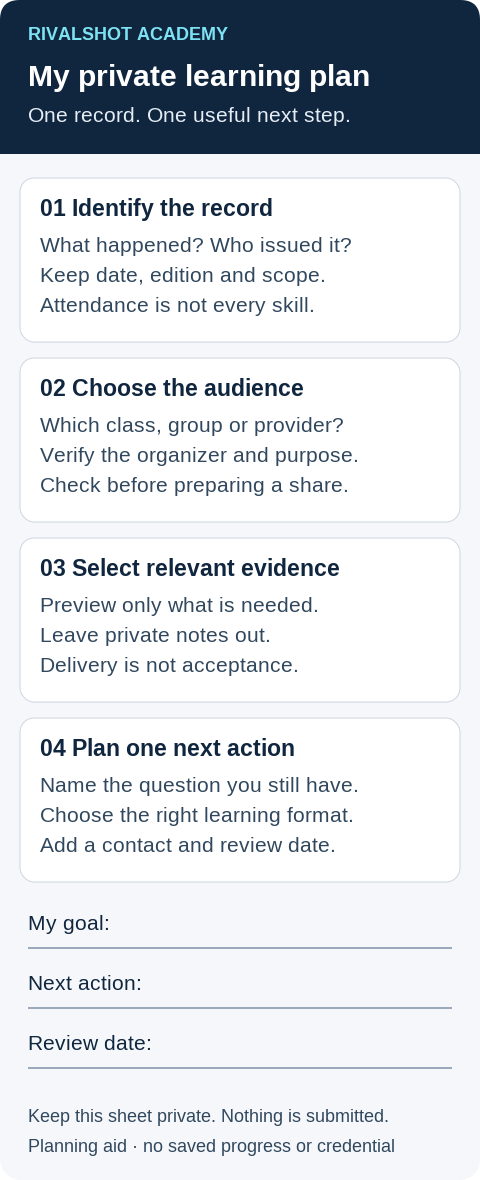
Download the editable diagram or plain-text worksheet. Fill it in privately; nothing is submitted here.
Download the figureDownload as text
Read the figure as text
RivalShot Academy — My private learning plan 1. IDENTIFY THE RECORD Reading, quiz, scenario, attendance and assessed skill are different. Keep the record type, issuer, title, date, edition and exact scope visible. Ask the issuer about missing records or corrections. Record type and title: Issuer and date: Edition and stated scope: Missing detail or correction to request: 2. CHOOSE THE AUDIENCE Verify the actual class, club, organizer or provider. Reading a guide does not grant enrollment, membership or conversation access. Check the intended audience before preparing a resource share. Group or recipient and purpose: Official contact or invitation route: Question or resource I want to discuss: 3. SELECT RELEVANT EVIDENCE Ask what the recipient needs, then preview only the relevant records. Exclude unrelated private answers, scores, routines and other people's details. Keep passwords and recovery codes out of the selection. Distinguish a prepared share, actual delivery and provider acceptance. Record(s) requested: Information I will leave out: Actual delivery state, if a send is performed: Provider response or acceptance, if received: 4. PLAN ONE NEXT ACTION Choose the learning format that fits your question. A guide, fictional scenario and supervised class serve different purposes. Use the provider's actual prerequisites and accepted evidence. My learning goal: What I can explain: What remains uncertain: My next action: Official source or person to consult: Review date: Keep this sheet private. It is a personal planning aid, not an issuer record, qualification, enrollment, message receipt or saved Academy progress. Reading and filling in this downloaded sheet submit nothing.
Think it through
- Which record do you have, and what claim does it support?
- What would a recipient actually need to see?
- What is one useful next learning action?
Keep your answers in your own notes. Nothing is submitted or scored on this page.
A question from “Read what a learning record actually says”
A provider confirms attendance at an orientation. What can you accurately describe?
- An independently assessed qualification for every activity
- Attendance at that orientation, within the provider’s stated scope
- Permission to skip another provider’s requirements
A question from “Share selected evidence for a stated purpose”
A send receipt appears after sharing a course record. What remains separate?
- The provider’s decision to accept that evidence for its requirements
- The identity of the record you selected
- The fact that you prepared a selection
Choose your next step
Sources
- W3C — Verifiable Credentials Data Model v2.0Introduction/abstract: credentials express issuer claims and the ecosystem distinguishes issuer, holder and verifier. Used only for those roles, not to claim RivalShot implements this standard or to establish credential acceptance. Checked 2026-10-18.
- Federal Trade Commission — Protecting Your Privacy OnlinePrivacy overview: everyday online activity can expose habits, tastes and activities. The learning-record selection examples are original editorial applications, not FTC prescriptions for Academy or credential systems. Checked 2026-10-18.
Original RivalShot explanatory prose and examples. Existing course manuscripts and first-visit planning aid retain their source identities.